


Zhou Yong’s Team at Xiangya School of Basic Medical Sciences Reveals a Key Mechanism Underlying Neutrophil NETosis in Acute Lung Injury
Time:2026-10-16 Author:Wenjing Zhong Visits:
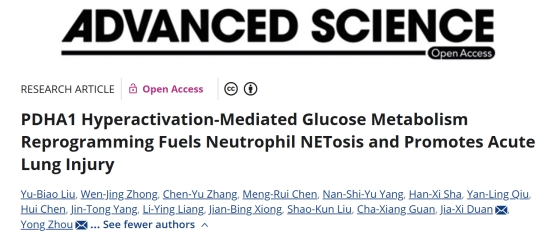
Recently, Professor Zhou Yong’s team from the Department of Physiology at Xiangya School of Basic Medical Sciences, Central South University, published an original research article online in the prestigious international journal Advanced Science, entitled “PDHA1 hyperactivation-mediated glucose metabolism reprogramming fuels neutrophil NETosis and promotes acute lung injury.” This study is the first to reveal that glucose metabolic reprogramming mediated by the hyperactivation of pyruvate dehydrogenase E1 alpha subunit (PDHA1) is a key mechanism driving the formation of neutrophil extracellular traps (NETs). The team also successfully developed 3-FP-BSA nanoparticles (3-FP-BSA NPs) designed to selectively inhibit PDHA1 in neutrophils, offering a new therapeutic strategy for acute lung injury (ALI) and acute respiratory distress syndrome (ARDS). Dr. Yubiao Liu, from the Department of Physiology at Xiangya School of Basic Medical Sciences, and Dr. Wenjing Zhong, a postdoctoral researcher, are co-first authors of the study. Professor Yong Zhou and Dr. Jiaxi Duan, from the Department of Geriatric Respiratory and Critical Care Medicine at Xiangya Hospital, are co-corresponding authors.
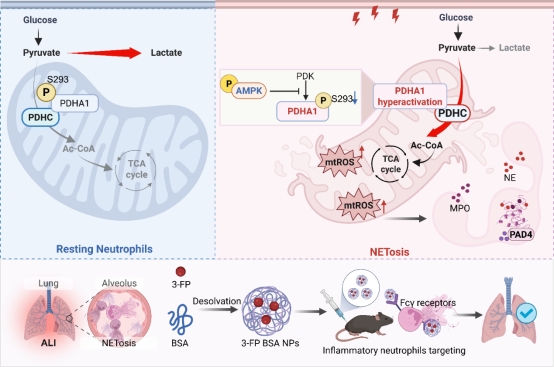
ALI/ARDS are life-threatening conditions commonly encountered in clinical practice and are associated with persistently high mortality rates. Neutrophil NETosis is a key event that amplifies pulmonary inflammation, but the mechanisms that trigger this process remain incompletely understood. Through single-cell data analysis, this study revealed an atypical pattern of glucose metabolic reprogramming in NETosis-associated neutrophils from mice with ALI and patients with ARDS, characterized by enhanced oxidative phosphorylation and reduced glycolysis. Further investigations using phosphoproteomics, pharmacological inhibition, and gene knockdown demonstrated that hyperactivation of PDHA1—driven by dephosphorylation at Ser293—is a key mechanism underlying excessive neutrophil NETosis during ALI. At the organismal level, the team developed nanoparticles (3-FP-BSA NPs) designed to inhibit PDHA1 in neutrophils selectively. These nanoparticles significantly suppressed NETosis and alleviated lipopolysaccharide (LPS)-induced ALI in mice. This study establishes the involvement of atypical glucose metabolic reprogramming in neutrophil NETosis and identifies PDHA1, a key metabolic hub, as a potential therapeutic target for ALI/ARDS.
Professor Zhou Yong’s research team focuses on lung injury and repair, systematically investigating the pathogenesis and therapeutic targets of respiratory diseases, including acute lung injury/acute respiratory distress syndrome (ALI/ARDS) and pulmonary fibrosis. The team has made a series of original research contributions in several areas, including metabolic immunological imbalance driven by abnormal glucose and lipid metabolism, mitochondrial dysfunction, alveolar epithelial cell loss, and cellular senescence. This study was supported by grants from the National Natural Science Foundation of China, the Natural Science Foundation of Hunan Province, and other funding agencies.
Full article: https://advanced.onlinelibrary.wiley.com/doi/10.1002/advs.78307