


Xiangya Researchers Develop Five-Minute Optomagnetic Assay for Cardiac Troponin I
Time:2026-10-14 Author: Visits:
Researchers led by Professor Bo Tian at Central South University’s Xiangya School of Basic Medical Sciences have developed a five-minute assay for cardiac troponin I (cTnI), a biomarker of cardiac injury. The work was published online in ACS Nano on October 7, 2026.
Detecting low-abundance biomarkers in whole blood is difficult because the sample matrix can interfere with measurement. The team developed OptoMagnetic Particle Spectroscopy (OptoMPS), a homogeneous biosensing technology for magnetic label-based immuno-agglutination assays.
Binding of cTnI to antibodies on magnetic nanoparticles induces particle agglutination, with changes in hydrodynamic size, effective magnetic moment and orientation-dependent Mie scattering. By coupling a biased oscillating magnetic field with near-infrared optical readout, OptoMPS converts changes in nanoparticle magnetization dynamics and scattering into magnetically modulated optical signals. Third-harmonic readout under nonlinear magnetic excitation suppresses the background contribution from unbound monomeric nanoparticles. Near-infrared excitation and magnetic modulation also help suppress interference from blood components.
The assay uses 5 μL of whole blood mixed with antibody-functionalized magnetic nanoparticles and other reagents. After 5 minutes of incubation with real-time measurement, OptoMPS achieved a limit of detection of 63 fM (1.54 pg/mL) for cTnI in a 10% (v/v) whole-blood assay mixture, without washing or plasma/serum separation. In a preliminary, single-center method comparison using 58 residual clinical whole-blood samples, OptoMPS measurements showed good correlation with a routine chemiluminescence immunoassay.
The team also reports that its first engineering prototypes based on patented technology are now available. Working with partners, it is exploring potential applications in coagulation assessment, early malaria screening and snake venom typing. The team welcomes clinical collaborations for method adaptation and validation.
The study involved Central South University, Beihang University, Huazhong University of Science and Technology, Xidian University, the University of Otago, and industry partner Danta Biotech Inc. Master student Yulin Yang is the first author, and Prof. Bo Tian is the corresponding author. The research was supported by the National Natural Science Foundation of China and Danta Biotech Inc.
Original research article: “Magnetization Dynamics-Modulated Near-Infrared Mie Scattering Enables Homogeneous Femtomolar Immunosensing for Whole Blood.” ACS Nano (2026). https://doi.org/10.1021/acsnano.6c15623
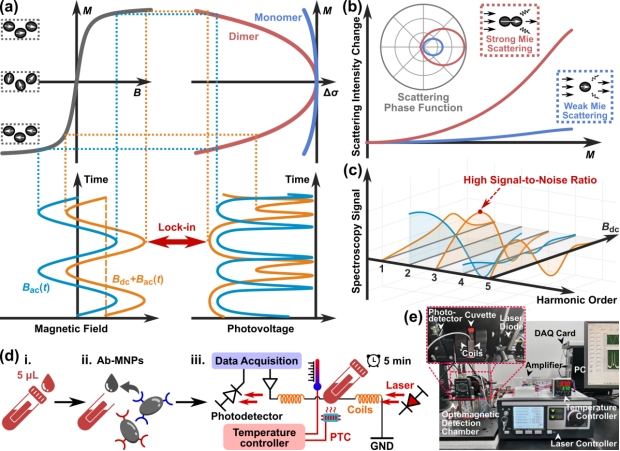
Figure 1. Principle and workflow of OptoMPS-based blood biomarker detection, including the 5 μL whole-blood assay and laboratory prototype.